The lab
How a park
is made.
Tegular, the game’s headless player, runs the game’s own physics, tries whole builds and measures what each park does. It found the builds behind Bell Garden and Bamboo Keys, and it checks the booth’s Gauntlet. The same rules let any park be played again, hit for hit.
One set of rules
TegularThe game and Tegular share one set of physics and stage rules. Tegular generates whole build schedules, the pieces placed before every wave, plays each one without a screen, and keeps the builds that behave differently. What it finds goes to the design notes; only chosen changes reach the game.
3 of 1,728builds of a single spring, every point and all eight aims, clear the Gauntlet, the booth’s hard level. An empty park loses after 7 seconds of sound.
84 s and 108 sof sound from the two designed builds that win it: a funnel and a spring, and two springs, then a bell.
63 of 64fresh arrival patterns in which a single Bell met Bell Garden’s goal. An empty park failed all 64.
673,017physics evaluations in one six-hour exploration of terrains.
Every park plays again
ReplaysA park is kept as its rules and the pieces placed before each wave, never as bead positions. The beads arrive on the same schedule every time, so playing a park again rebuilds the same run.
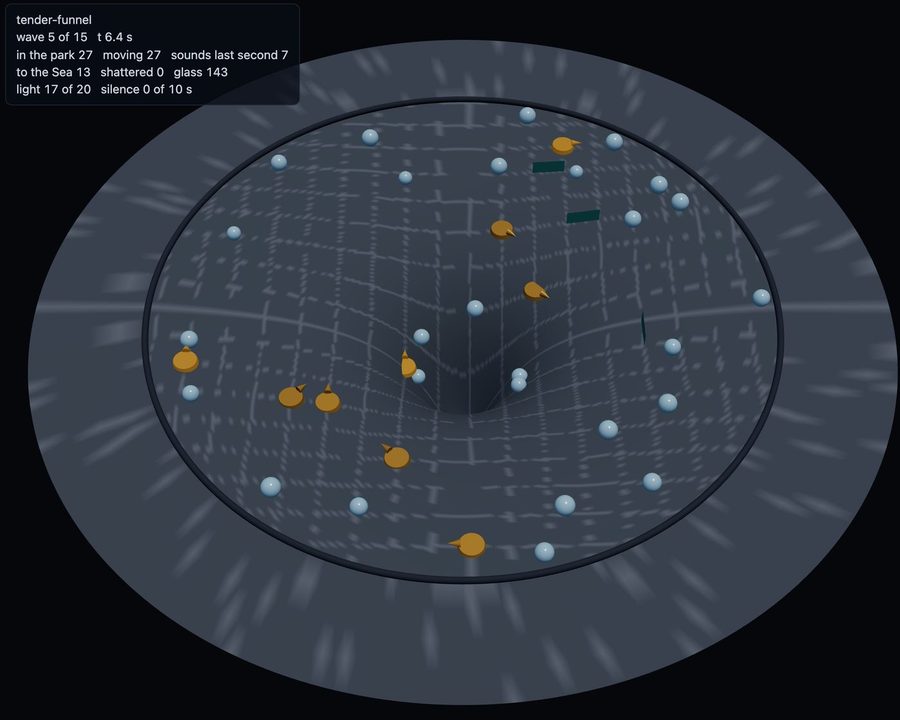
Harness replays
Sixteen parks that simulated players built on 1 October, re-run in the browser with the same rules. Each player has a style: a tender loses few beads and never lets the park go quiet, a composer keeps it sounding, a metronome plays for rhythm, a pumper buys springs whenever it can. They played the rules of that day, before the levels.
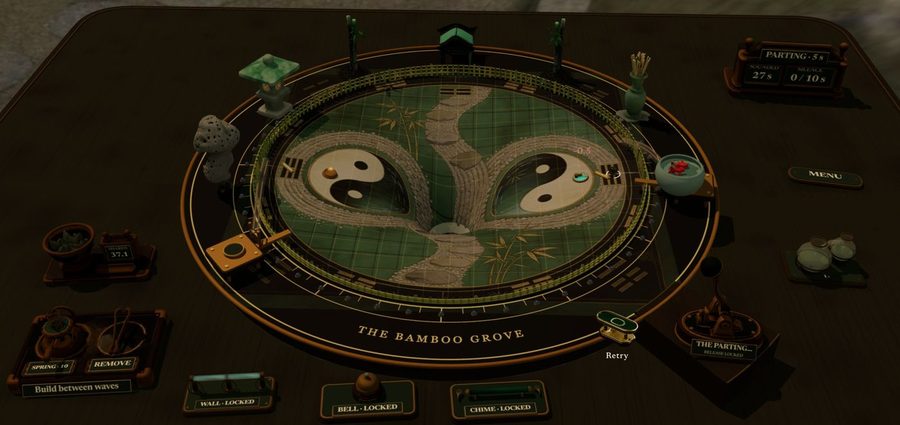
Watch
A filmed level keeps a build for every wave. Watch places that wave’s pieces, waits a moment so they can be seen, and pulls the lever itself. The booth’s screensaver is Watch, moving from one filmed level to the next.
The same notes
The sound is part of the replay. An offline tool plays a recorded scene through the game’s own simulation and renders its notes, and refuses to run if any simulation or sound file has changed. In a check of a chord scene, its second wave played the same 22 notes in the game and offline.
The pieces
In the gameEach piece costs shards, and every hit earns some back. The five levels bring in the spring, the wall, the bell and the chime; the booth’s wild parks open every piece.
- Spring
- Kicks a bead in the direction it is aimed. 10 shards, and half a shard for every kick.
- Wall
- Turns a bead back. The first three are free.
- Bell
- Throws a bead straight out from its centre, away from where it hit. 12 shards.
- Chime
- Sounds a note as a bead rolls across it, without slowing the bead. 6 shards.
- Cup
- A hollow where a slow bead can come to rest. 8 shards.
- Vortex
- Speeds a bead up or brakes it, and costs upkeep. 16 shards.
- Remove
- Takes a piece back. One that never played returns its full cost.
Places and beads
AssetsEach level is a board set in a place from Hermann Hesse’s novel: thirteen places, seventeen bead subjects and fifty-seven props.